What's the Difference Between an Advance Directive and a Living Will in Arizona?
3 min read
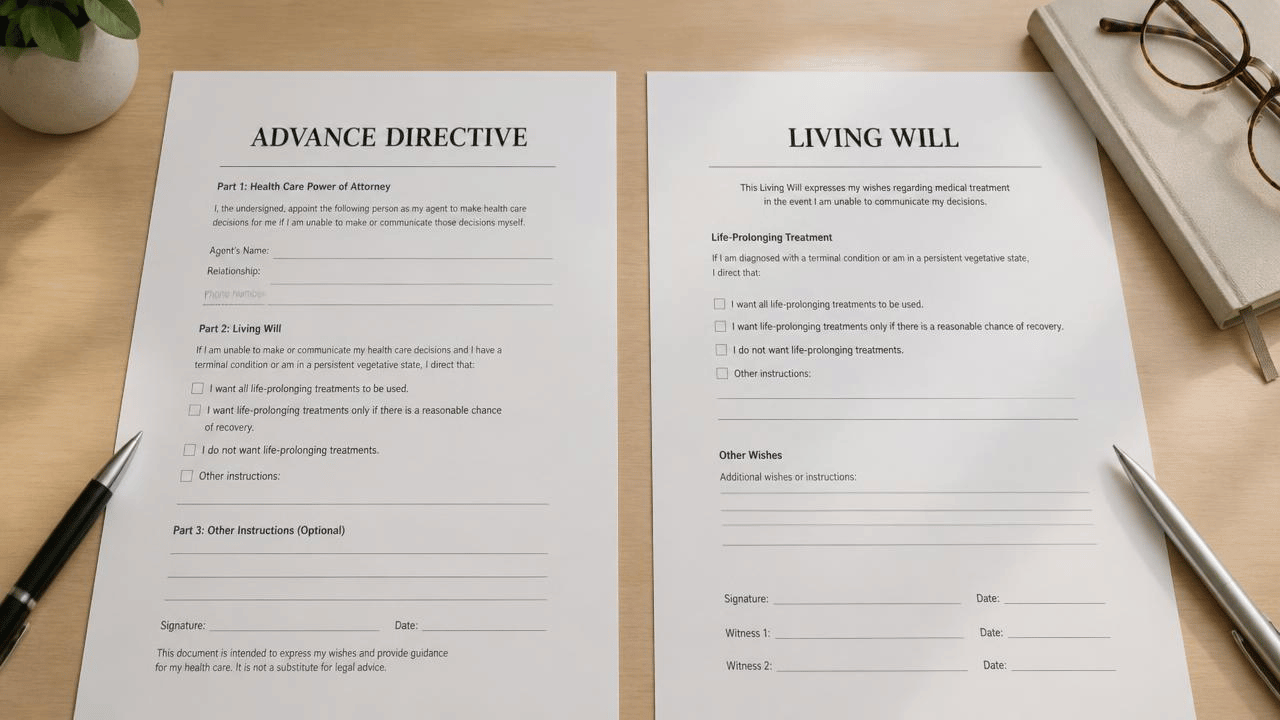
A living will is one kind of advance directive. "Advance directive" is the umbrella. A living will is one of the things standing under it.
I hear the two used like they mean the same thing all the time. In doctor's offices. In attorney's offices. In my own kitchen, years ago, before I knew better. And that mix-up costs people. They think they're covered because they signed "the form." Then something happens, and it turns out they signed the wrong one, or only half of what they needed.
The four documents under the Arizona umbrella
Arizona law recognizes several kinds of health care directives. These are the ones that matter most.
Health care power of attorney. Names a person, your agent, to make medical decisions when you can't. This is the who. (A.R.S. § 36-3221)
Living will. Puts your treatment wishes in writing. Life support, feeding tubes, CPR, comfort care. This is the what. It can stand on its own or be attached to your health care power of attorney. (A.R.S. § 36-3261)
Prehospital medical care directive. Most people call it the orange form, because it has to be printed on orange paper. It tells paramedics and EMTs not to resuscitate you. It only works outside a hospital, and it needs your signature and a licensed health care provider's. (A.R.S. § 36-3251)
Mental health care power of attorney. A separate document for decisions about mental health treatment. Most people have never heard of it, and plenty of plans skip it entirely. (A.R.S. § 36-3281)
Why you want both the who and the what
A living will without an agent is a list with nobody to read it out loud. A health care power of attorney without a living will hands someone a decision with no map. Your agent ends up guessing. And then they live with the guess.
I've sat across from people who still wake up wondering if they chose right for someone they loved. Years later. Still wondering. Some nights, I'm one of them. Writing your wishes down is one of the kindest things you can do for the person you name. You carry the weight now, so they don't have to carry it later.
What Arizona requires to sign them
For both the health care power of attorney and the living will, Arizona keeps it simple. You sign and date it. Then it's either notarized or signed by at least one adult witness. Your agent can't be the witness. Neither can anyone involved in your medical care. If you use only one witness, it can't be a relative or someone who would inherit from you.
You don't need a lawyer to make a valid directive in Arizona. You do need it done right. A missing signature or the wrong witness, and that form can fail you at the exact moment it's supposed to work.
Then make sure it can be found
If nobody can find it, you might as well not have it. Give copies to your agent, your doctor, and anyone likely to get the first phone call. If you have an orange form, keep it somewhere visible at home. The refrigerator door is where paramedics are trained to look.
The Arizona Attorney General publishes free Life Care Planning forms if you want to start there. If you'd rather have someone sit with you while you figure out what you actually want to say on them, that's what I do. Book a free 20-minute call and we'll start there.
This article is educational and is not legal advice. For legal questions about your situation, talk with an Arizona attorney.
I'm Jennifer Michaels, CDP®, founder of GuideWyze. I learned most of this the hard way. Now I help families do it with a little less guesswork.